Well, well, well, if it isn't another fiery hiccup in the high-stakes, low-orbit drama of space exploration! Jeff Bezos's Blue Origin just had a rather explosive — shall we say, enthusiastic — "hot-fire" test of their New Glenn rocket down in Cape Canaveral, Florida. The result? A 320-foot-tall rocket, a massive fireball, and a whole lot of shaking in nearby homes. Our space billionaires just can't catch a break, can they?
Fireball Frenzy
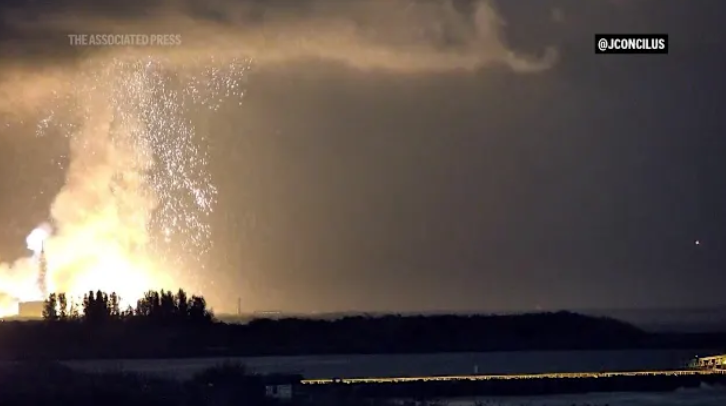
It all went down on a Thursday night around 9 p.m. local time. Videos promptly blew up the internet (pun absolutely intended), showing the humongous New Glenn rocket doing its best impression of a Roman candle, igniting on the launchpad before erupting into a colossal, bright orange ball of fire. We're talking engulfing the entire area kind of fire. Quite the light show, though probably not the one Blue Origin was aiming for.
Blue Origin, ever the masters of understatement, confirmed they'd experienced an "anomaly" during the test. For those not in the know, a "hot-fire" test is essentially when a rocket gets to flex its engines while staying firmly anchored to the ground. Think of it as revving your car in neutral, except if your car then decided to spontaneously combust.
Bezos Weighs In (and Musk Chimes In Too, Obviously)
Jeff Bezos himself took to X (formerly Twitter, for those still keeping score) to give his two cents. "Very rough day, but we'll rebuild whatever needs rebuilding and get back to flying. It’s worth it," he posted, adding that it was "too early to know the root cause" of the spectacular fiery display. Good to know everyone's safe, though – Bezos confirmed all personnel were accounted for.
And because you can't have a space drama without the other main character, Elon Musk, Bezos's favorite commercial space rival, quickly popped up on X too. "Sorry to see this, I hope you recover quickly," Musk wrote, adding the ever-so-helpful observation, "Most unfortunate. Rockets are hard." Thanks, Elon, truly groundbreaking insight there.
Even NASA Administrator Jared Isaacman issued a statement, acknowledging the "anomaly" and promising to work with partners on a "thorough investigation" to assess impacts and "get back to launching rockets." Sounds like standard operating procedure when things go BOOM. The U.S. Space Force's Space Launch Delta, who oversees all East Coast space launches, echoed these sentiments, noting that such developmental testing "carries inherent risk, including the potential for anomalies." Translation: sometimes things blow up, it's just part of the job.
A String of Setbacks
This fiery incident isn't exactly Blue Origin's first rodeo with bad luck. Just last April, the New Glenn rocket got grounded by the FAA after a launch that, well, didn't quite stick the landing – leaving a satellite stranded in the wrong orbit.
Dr. Maggie Lieu, an astrophysicist over at the University of Nottingham, didn't mince words. She called this latest explosion a "massive setback," especially since the FAA grounding had just been lifted. "We thought it was quite a quick turnover that they were able to go from a grounded rocket to back on the launchpad so quickly. This is huge damage. The whole launch facility has gone, so it’s going to take many, many months to get back on board and then for the FAA to re-clear this, because this is a mishap." Ouch.
Blue Origin and SpaceX are locked in an epic billionaire space race, both vying for dominance in commercial space travel and both tapped by NASA to eventually shuttle astronauts to the moon. Despite their rivalry, Bezos actually had some nice things to say about SpaceX recently, telling CNBC that "Great industries are made up of many companies" and admiring SpaceX's achievements. Maybe a little less admiration for the explosion, though.
Speaking of SpaceX, while they're launching rockets left and right (165 in 2025 – more than the rest of the world combined!), even their gargantuan Starship rocket has seen its share of dramatic failures, with its latest test ending with a booster taking an unexpected dip in the ocean.
New Glenn's personal journey has been a bit of a bumpy ride too. Way back in 2024, two sections of the rocket got damaged at the factory. Its first launch in January 2025 made it to orbit, but the booster decided to skip its re-landing on the ship. A second flight was smooth sailing, but then came the infamous April 19th flight with the faulty upper stage, leaving a commercial satellite in the wrong address and prompting the FAA to slap a grounding order on it. Blue Origin blamed a "bad engine" for that one.
Despite all this, NASA recently threw Blue Origin a bone – a cool $188 million contract for New Glenn to deliver rovers to the moon as part of the Artemis program, which aims to establish a permanent human presence on our lunar neighbor. Guess they'll have to figure out how this latest "anomaly" impacts those plans.
What's Blue Origin's Big Idea, Anyway?
Bezos founded Blue Origin in 2000 with a lofty goal: to slash the cost of space travel and space tourism, making it an affordable reality for more than just the ultra-rich. They scored a major win with an unmanned rocket launch in 2015, and then really hit the headlines in 2021 when Bezos and his brother took the company's first manned spaceflight. Apparently, Katy Perry and Bezos's wife Lauren Sanchez were among a group of six women on Blue Origin's eleventh and most star-studded tourist flight in April 2025.
Both New Shepard and New Glenn are designed to be reusable (that's the magic sauce for cutting costs, folks), but it looks like they might need a few more cycles in the test lab before they're reliably flying high. Here's hoping Blue Origin bounces back quickly – we're all here for the space drama, but maybe with a little less actual fire next time.