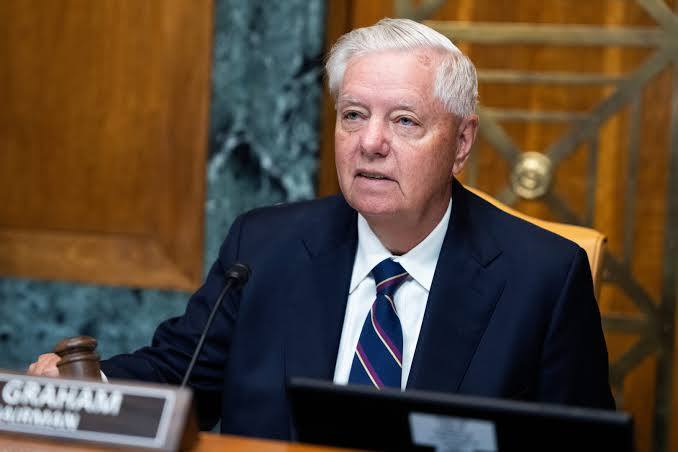
In a bombshell announcement that sent shockwaves through Washington D.C. and beyond, Senator Lindsey Graham, Republican from South Carolina, has passed away at the age of 71. His office confirmed the devastating news early Sunday, revealing that the long-serving senator succumbed to a "brief and sudden illness" on Saturday night.
The political world is reeling, and tributes are pouring in for the man who was a fixture in the Senate for over two decades and a close ally of former President Donald Trump.
A Sudden End for a Political Giant
While details surrounding the senator's sudden passing remain somewhat scarce, NBC News has obtained police scanner audio indicating that emergency personnel responded to a "cardiac arrest" call at Graham's Capitol Hill home on Saturday evening. Photos from the scene show paramedics transporting an individual on a stretcher from the residence to an awaiting ambulance, with multiple police and fire vehicles also present.
A top staffer for Senator Graham told NBC News that there were no prior indications he was feeling unwell. This makes his death all the more shocking, especially as he was slated to appear on NBC News' "Meet the Press" just hours later on Sunday.
His family has requested privacy during this incredibly difficult time, asking for prayers as they grieve.
Tributes Flood In for a "True American Patriot"
The news immediately triggered an outpouring of condolences and tributes from across the political spectrum. Former President Donald Trump took to Truth Social, describing Graham as "one of the greatest people and Senators I have ever known" and a "true American Patriot." High praise indeed from a leader Graham initially opposed fiercely in the 2016 primaries, famously warning, "If we nominate Trump, we will get destroyed." Their relationship, however, dramatically evolved, with Graham later becoming one of Trump's most vocal supporters and even calling himself the president's "north star" in a recent interview.
Other prominent figures joining the chorus of remembrance include Senate Majority Leader John Thune, who lauded Graham as a "strong advocate for the United States and a strong ally to freedom-loving countries across the globe." South Carolina Governor Henry McMaster praised him as "the fiercest of fighters for South Carolina and America—and a loyal and steadfast friend."
International leaders also weighed in, with Ukrainian President Volodymyr Zelenskyy mourning the loss of a "true defender of freedom" who had visited Ukraine ten times during the war. Zelenskyy revealed they were in "constant dialogue" and that Graham was working on "important initiatives" to bring peace closer. NATO Secretary-General Mark Rutte echoed these sentiments, calling Graham a "powerful advocate for America" and a strong believer in the NATO Alliance. Even Israeli Prime Minister Benjamin Netanyahu expressed his grief, stating Israel had "lost one of its greatest friends."
Interestingly, even in Iran, where state media described him as an "anti-Iran" war hawk, his passing garnered attention. The country's exiled former crown prince, Reza Pahlavi, noted on X that Graham "stood alongside the people of Iran in their struggle against tyranny."
A Life of Service and Influence
Born in Central, South Carolina, Lindsey Graham's journey to the Senate began after his parents ran a restaurant and pool hall. He was the first in his family to attend college, earning a law degree from the University of South Carolina before embarking on a distinguished military career. He served 33 years in the U.S. Air Force, Air Force Reserves, and South Carolina Air National Guard, retiring as a Colonel in 2015 while simultaneously serving in Congress.
Graham first entered the political arena as a U.S. Representative from 1995 to 2003, before successfully running for the Senate in 2002 to fill the seat vacated by the legendary Strom Thurmond.
Throughout his career, Graham became known as a powerful voice on foreign policy. He was a vocal proponent of American intervention and a hawkish stance against adversaries. He famously formed the "Three Amigos" with fellow senators John McCain and Joe Lieberman, all sharing robust views on international affairs. More recently, he was a key figure pushing both the Trump and Biden administrations to support Ukraine against Russian aggression and advocated for a tough stance against Iran.
Michael A. Horowitz, a geopolitical analyst, described Graham as the Republicans' "last highly effective advocate for the idea that American power must shape events before hostile powers reshape them." Horowitz noted that in the Trump era, Graham's influence shifted to "shaping Trump’s own instincts, using loyalty and flattery to keep hard‑line positions on Iran, Ukraine, and Syria in the room."
Within the Senate, Graham chaired the Senate Judiciary Committee from 2019 to 2021 and most recently led the Senate Budget Committee, where he played a crucial role in orchestrating a major tax cut and spending package during Trump's second term.
The Aftermath: What Happens Now?
Graham was actively seeking a fifth six-year term in November, having just defeated primary challengers in June. His sudden death throws a wrench into the South Carolina political landscape. Under state law, Governor Henry McMaster will appoint a temporary replacement to serve until January 3, 2027. Furthermore, South Carolina Republicans will now have to find a replacement nominee for the upcoming election, with a special primary election expected by August 11.
Graham's passing also comes as another prominent Republican, Senate Minority Leader Mitch McConnell, remains hospitalized after experiencing cardiac arrest last month. While a McConnell spokesperson stated he is recovering, further details on his condition have not been released.
The political world has lost a truly unique and influential figure. Lindsey Graham's impact on domestic and foreign policy, his complex relationship with Donald Trump, and his decades of service will undoubtedly be remembered as a significant chapter in recent American history.