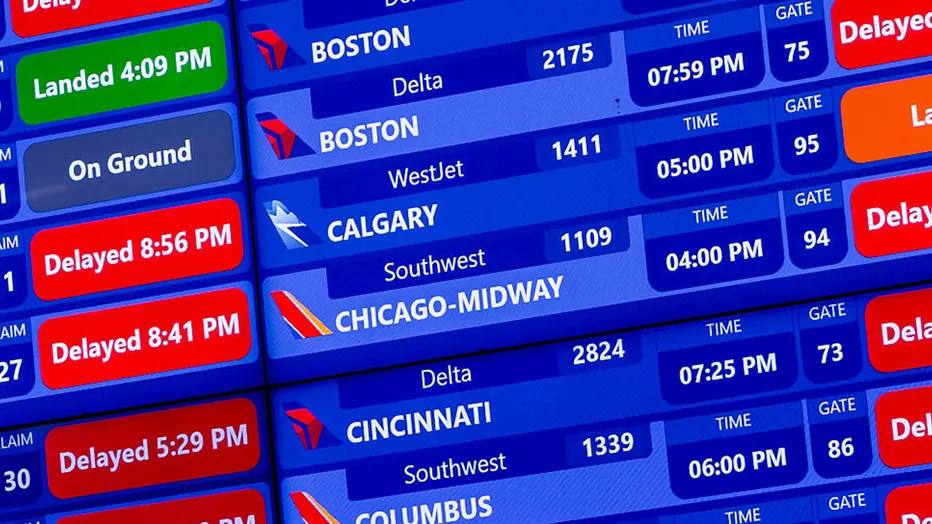
Airlines canceled thousands more flights Saturday as they tried to dig out from the longest nationwide ground stop since the Sept. 11, 2001, attacks. The Federal Aviation Administration halted departures for more than four hours Friday after old routers and switches got overloaded, Transportation Secretary Sean Duffy said, and Homeland Security Secretary Markwayne Mullin said officials had found no evidence of a cyberattack.
FlightAware logged 9,132 U.S. cancellations Friday, and by Saturday morning the two-day total was already more than 12,500, ABC News reported. Saturday's cancellations had climbed past 3,700 by about 9:40 a.m. ET, according to CNBC and NBC News, which cited FlightAware. CNBC noted that some of Friday's disruptions were also tied to weather.
https://twitter.com/FAANews/status/2121439275539481030
"Give us the money to fix it"
Duffy said the trouble started just after 3:30 p.m. ET Friday, when more than 3,500 planes were in the air. In a later timeline he posted, the FAA flagged telecommunications problems at facilities and TRACONs at 3:36 p.m. ET. The ground stop was lifted at 8:15 p.m. ET.
"We have old switches, old routers, we use 1980s little copper lines," Duffy said at a White House briefing Friday night, according to Yahoo News. "It's an old system that went down. It went down everywhere. It got overloaded."
Mullin said the outage happened as the FAA was installing upgrades. "The new technology was overwhelming the older system," he said, according to the Los Angeles Times. "The patchwork doesn't work. We need one complete system."
The picture got sharper over the weekend. The Wall Street Journal reported that the trouble was traced to a newly installed router at an FAA radio site in El Dorado, Arkansas, a city of about 22,000 some 210 miles northeast of Dallas, with a radar site in Amarillo, Texas, also sending a barrage of traffic. Contractor L3Harris Technologies had just put in a new router made by HPE's Juniper Networks at the Arkansas site as part of a copper-to-fiber swap, the Journal reported. Not long after it went live, the machine started flooding the network with data. FAA technology chief Rebecca Guy said Saturday the two sites were "pinging our network at a very high rate, a thousand connections over every four to five seconds." That flood hit 17 of the FAA's 22 high-altitude control centers, FAA Administrator Bryan Bedford said, and the agency ordered the ground stop.
On the Sunday shows, Duffy said the El Dorado work was a replacement of old copper that was about to be shut off, and that when the new router was turned on, a system L3Harris had replaced in Amarillo about three weeks earlier started flooding the network too. Officials isolated both sites and disabled a broadcasting function on about 60 similar routers, and the system stabilized. The hardware is now in an L3Harris lab in Florida, with FAA staff on site and the FBI offering support, Duffy said. The root cause is still an open question — a bad install, a bad configuration, or a bad piece of equipment. An HPE spokesman told the Journal the Juniper devices "did not fail" and appeared to be working as intended. L3Harris said it takes the outage seriously and is supporting the investigation.
On the cyber question, Mullin was careful. "There is nothing certain right now. It doesn't appear that way," he said, according to Yahoo News. The Department of Homeland Security later posted that officials had "seen zero evidence that this was a cyber attack."
Then came the ask. "I want $50 billion," Duffy said Friday night, according to The Hill. "Let's finish this job: new hardware, new software, new telecommunication." He warned, "You will have more of them unless the American people and the Congress tell us to build," ABC News reported. Mullin put it more bluntly: the outdated system "hasn't been a priority from Congress," and "this is what happens when Congress kicks the can down the road."
https://twitter.com/SecDuffy/status/2121429359420420310
https://twitter.com/DHSgov/status/2121428732841734294
The bill is already sitting there
This is not a brand-new request. Congress approved $12.5 billion last year as part of the 2025 "Big Beautiful Bill," the sprawling Republican reconciliation package Duffy has called a "down payment." The House passed that bill 218-214, CBS News reported, with every House Democrat — and two Republicans — voting no. Their public case against the package centered on Medicaid, tax cuts and energy provisions, not a standalone vote against air traffic control, KPBS noted at the time.
The follow-up money is the part that has not moved. In late September, Sen. Eric Schmitt, a Missouri Republican, introduced the Modern Skies Act, a $30 billion measure the FAA said would finish the digital architecture behind air traffic control, replace aging towers and fund airport upgrades. Airlines, pilots and the National Air Traffic Controllers Association endorsed it. The bill has been sitting in the Senate Commerce Committee. On Friday, before the sky shut down, Duffy had already been pressing congressional leaders for about $30 billion more, Wired reported. After the outage, he raised the number to $50 billion and, on X, told Congress to "PASS THE MODERN SKIES ACT NOW."
On the Sunday shows, Duffy said that $12.5 billion is already spoken for — radars, radios, electronic flight strips — and "I have no money for a new network." The FAA said Friday's failure was in the legacy telecommunications system, not at towers already upgraded with that down payment. He told the Journal that until the copper is replaced at the end of 2028, more disruptions could come.
Republicans still hold the gavel in this lame-duck session. Democrats, after winning both chambers in this month's midterms, take over in January. Leading Democrats have so far answered the crisis with investigations, not a yes on the check. Sen. Tammy Duckworth of Illinois, the ranking Democrat on the aviation subcommittee, said the ground stop "will warrant a thorough and complete investigation" and that she would be "demanding answers from the FAA." Sen. Maria Cantwell of Washington said the Commerce Committee will review the technology issues. Rep. Ted Lieu of California called for hearings and said he urged "the FAA and the Trump administration to make sure this never happens again," the Los Angeles Times reported.
Duckworth also punched back at Duffy's decision to blame Congress. "You've literally controlled Congress for the past two years," she posted. "And apparently, there's always been money for vanity projects. But none to fix our air traffic control system? Perhaps Trump should prioritize aviation safety over his pathetic Arch."
https://twitter.com/SenDuckworth/status/2121444497733337170
That history cuts both ways, and it does not get travelers home. No one has held a vote yet on the $50 billion Duffy demanded Friday night, and no Democrat has been quoted refusing that specific ask. What they have done is vote against the package that included the last down payment, leave the $30 billion Modern Skies Act untouched, and greet the worst ground stop in a quarter century with promises of hearings. Duffy said Saturday morning that operations were slowly coming back, with more delays and cancellations as airlines reposition planes and crews. Hearings will not reboot a 1980s router. The new majority can fund the overhaul, or it can explain the next time the country is stuck on the tarmac.
Photo: Larry D. Moore via Wikimedia Commons, CC BY 4.0