The company that put a camera on your porch now wants one buzzing through the living room.
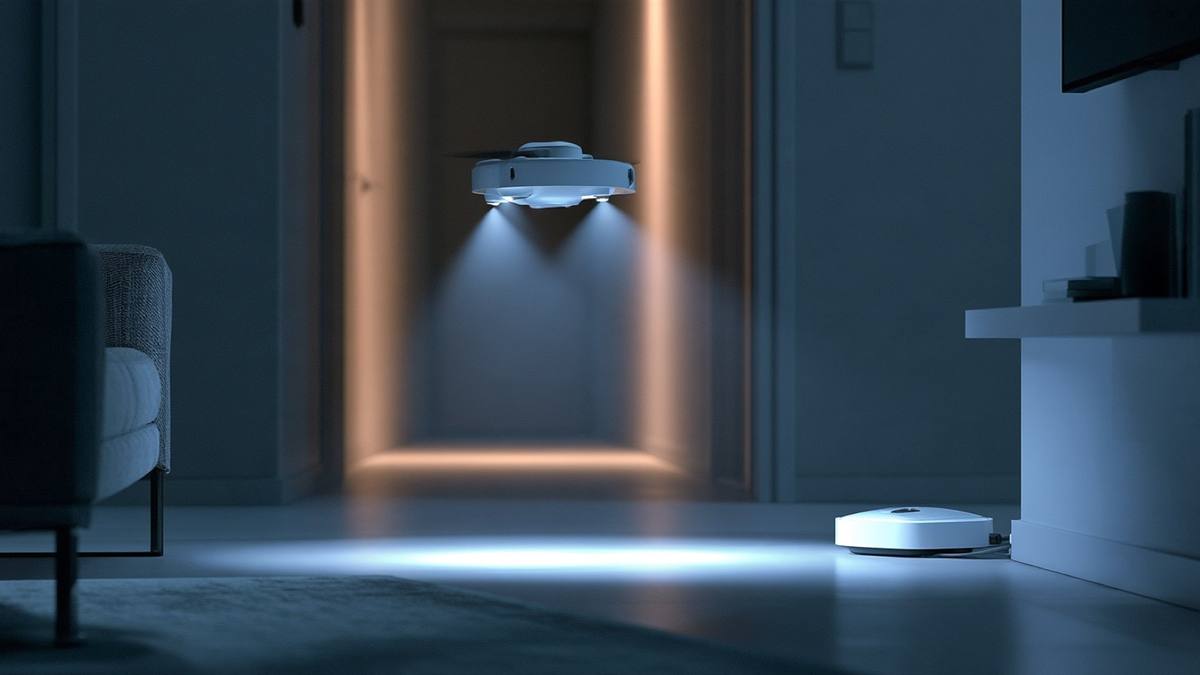
Amazon's Ring on Tuesday unveiled Ring Robotics, a new line of machines that do not sit still on a wall. The headline act is the Ring Drone Cam, a flying indoor security camera priced at $249.99, according to Ring's official announcement and product page. It is built to patrol a home room to room, then fly itself back to its dock. A second machine, the Ring Rover Cam, is a $999.99 wheeled security robot aimed at businesses.
Collin Rugg shared a Ring promo clip Tuesday morning PT that shows the drone lifting off, flying a house, lighting up a dark room, and the Rover rolling through a shop. Within a couple of hours, the post had about 15,000 impressions and nearly 5,000 video views.
https://twitter.com/CollinRugg/status/2120201233634136216
A flying camera, years in the making
Ring has been chasing this idea for a long time. The company first previewed a flying indoor camera, then called the Always Home Cam, in 2020, and it never widely shipped. The Verge reported that founder Jamie Siminoff told a New York launch event this week the company has been developing a drone since 2016 and came close to shipping two earlier models. This one, he said, is due to start shipping in the U.S. on January 27, 2027 -- with a catch.
Ring's own fine print says the Drone Cam "has not been authorized as required by the rules of the Federal Communications Commission" and "may not be offered for sale or lease" until that authorization comes through. For now, the company is taking email sign-ups, not preorders, GeekWire noted.
If it does ship, here is what Ring says you get. The drone records in 2K video, with a 148-degree field of view, and can rotate 360 degrees. Two LED lights kick on in the dark. It is indoor use only. Ring's product FAQ says it can fly for up to eight minutes on a charge, then return to the dock on its own when the flight is over or the battery runs low, under tested conditions. The Verge, which got hands-on time at the event, put the weight at 165 grams and said it records only while flying; the camera is shuttered when it is docked. Ring's FAQ also says the drone has no microphone, speaker, two-way talk or siren.
You do not fly it like a toy. Ring says you set custom routes and viewpoints in the app, send it to a room or a spot on a map, or launch it yourself. When a compatible Ring camera, sensor or alarm is triggered, the drone can automatically fly to a preset point to investigate. Scheduled patrols, the company says, require a compatible Ring Protect plan. Ring did not say which plan tier qualifies, GeekWire reported. Official Ring Protect plans currently start at $4.99 a month for Solo.
Both new machines run on what Ring calls AI Pilot, a system that uses the devices' cameras, vision models, on-device sensors and cloud processing to map a space, suggest patrol points and navigate around obstacles. Siminoff, in Ring's announcement, put the pitch this way: "For years, customers told us they wanted eyes in the places a fixed camera couldn't reach, and peace of mind in the spots they'd never want one. The honest answer wasn't more cameras; it meant reimagining what a security device could be."
At a New York demo on Monday, he offered a more vivid sales line, according to CNBC. "If someone is going around your house at night, and your motion detector goes off on your Ring doorbell, imagine if you see spotlights and something flying across the window," Siminoff said. "You're probably not going to go into that house."
CNBC also reported that he said the drone is not supposed to fly outside, citing FAA rules, and that Ring has "put guardrails in there to make it so it doesn't fly outside."
A robot for the shop floor
The Rover Cam is the business half of the launch. Ring's site prices it at $999.99, with U.S. preorders open and shipping slated to start December 16, 2026. The company says it can autonomously map and patrol indoor spaces of up to 5,000 square feet, stream and record in up to 4K while it is moving, pop up a periscope camera to see over counters and shelves, and use a built-in siren, light tower and two-way audio. It can also start recording if it detects a person while it is still docked, Ring says.
Ring describes the Rover as a purpose-built security robot "inspired by feedback from Amazon Astro customers" and says the team "leveraged the best of Astro" rather than simply selling a home robot that also does security. CNBC, WIRED and Engadget all noted how closely it resembles Amazon's earlier Astro robot.
Privacy, and a loud buzz
Ring says privacy is the default: the drone powers down in its dock with the camera off, the Rover can drop into a Sleep Mode that retracts the periscope and turns off the microphone, and both flash LED indicators when they are recording. Videos, the company says, are protected by its Throw Away the Key encryption. It also leans into the noise. The official announcement notes that the drone's propellers "aren't quiet," and that both machines are "built to deter, not just monitor."
Not everyone is sold. WIRED reported that Thorin Klosowski, a senior security and privacy activist at the Electronic Frontier Foundation, said people should "think through" how a device like this will make others in the home -- or visitors -- feel. "I think the companies who make these sorts of surveillance products are invested in us feeling less safe at home," Klosowski told the magazine.
On X, early reaction to Rugg's clip included jokes about coming home late and getting tailed down the hallway by a drone. The bigger test lands later. The Rover is due first, in December. The flying camera still has to clear the FCC before it can actually be sold.