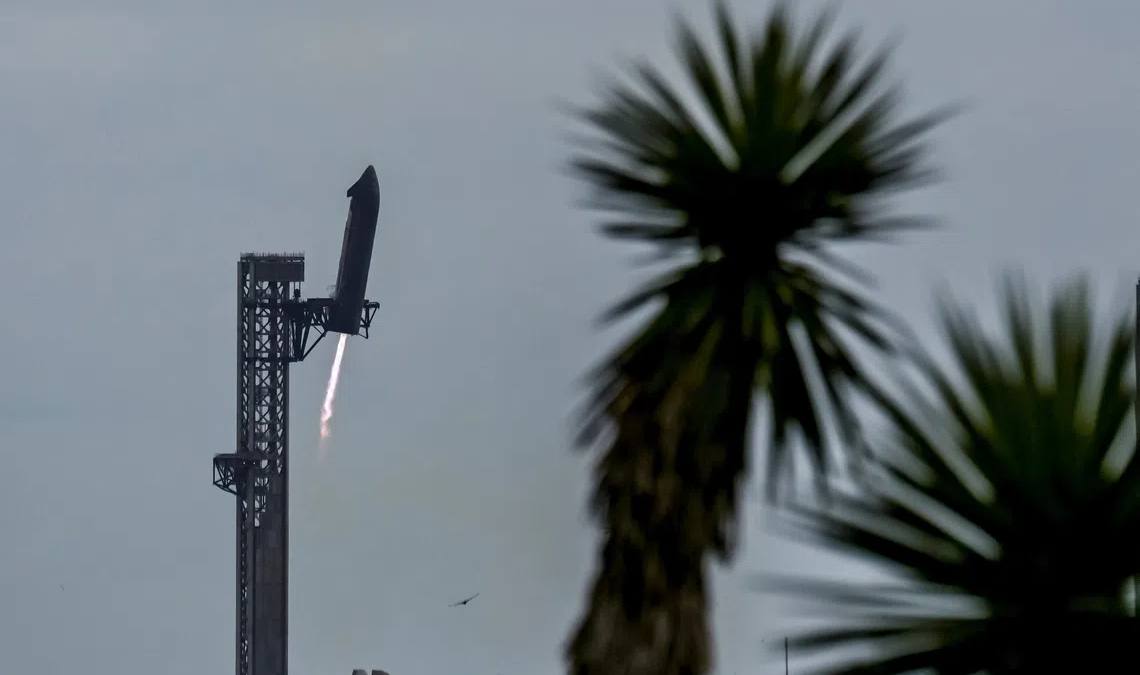
SpaceX just did the thing that used to look like a video game cutscene. On Saturday afternoon, the company's launch tower in South Texas reached out with its giant mechanical arms — the ones everyone calls the chopsticks — and caught the Starship upper stage as it dropped back in from orbit.
It was the first time SpaceX had ever caught the ship after a flight from space. The moment came at about 3:20 p.m. local time at Starbase, roughly 22 and a half hours after Flight 15 left the same pad. Space.com put the catch at about 4:20 p.m. ET.
https://twitter.com/SpaceX/status/2121715216597827756
SpaceX did not bury the lede. "Mechazilla catches Starship! Congratulations to the entire SpaceX team on this incredible achievement!" the company posted, with video of the stainless-steel ship settling into the tower.
Flight 15 lifted off Friday at 4:47 p.m. CT from Starbase, according to Space.com. The plan was even bigger than the ending they got: catch both the Super Heavy booster and the ship, which SpaceX had previewed as the first full recovery of an orbital launch system. The booster did not cooperate.
Minutes after liftoff, Super Heavy — Booster 22, the first of the new V3 boosters to try a tower catch — aborted its return and diverted to the Gulf of Mexico, where it exploded before hitting the water. SpaceX spokesperson Kate Tice said Saturday that early indications were the booster ended its boostback burn early because of a low fuel mass alarm, then correctly aborted when guidance saw it was out of position, Space.com reported. SpaceX has caught Super Heavy three times on earlier flights. It had never tried the trick with the ship, which flies higher and comes in faster.
The ship, known as Ship 42, kept going. It reached orbit for only the second time in the program's history, after September's Flight 14, and deployed 26 Starlink V3 satellites, SpaceX said. Elon Musk posted that the vehicle was completing 14 orbits of Earth before the deorbit burn and the attempt to land at Starbase.
https://twitter.com/elonmusk/status/2121611711278981147
After a 10-second, single-engine deorbit burn around 3:23 p.m. ET, the ship punched back through the atmosphere and lined up on the tower. SpaceX's Dan Huot, calling the landing on the company's webcast, did not play it cool.
"That that was the missing link," Huot said, according to Space.com. "That was the holy grail of space flight, plummeting through fire to be snatched out of the air by steel. We caught a Starship, and now everything changes."
Space watcher Sawyer Merritt, posting catch video as it happened, called it the first recovery of a conventional orbital rocket upper stage in history. SpaceX and major outlets including the Associated Press, CNBC, BBC News and Space.com confirmed the narrower, solid fact: this was the first time the company had caught the Starship upper stage after a flight from orbit.
https://twitter.com/SawyerMerritt/status/2121715055901155519
That is still a very big deal. Fully catching both stages would have been the clean sweep SpaceX wanted, and the booster's splashdown-and-fireball means Flight 15 did not get there. What it did get is the harder catch, the one that had never been tried. SpaceX needs a rapidly reusable Starship to fly often, stock Starlink, and, someday, send cargo and crew to the Moon for NASA and, in Musk's telling, on to Mars. Saturday, the chopsticks closed, the ship hung over the Texas coast, and for a few minutes the future looked like it had already shown up.
Photo: SpaceX