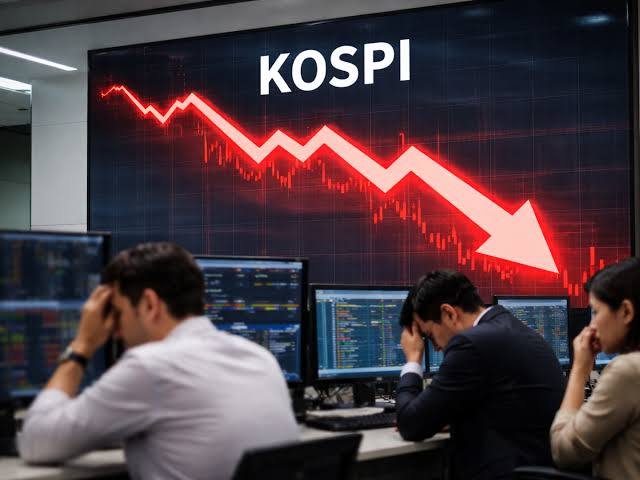
Alright, gossip hounds, gather 'round! We've got some juicy, albeit tragic, news from the world of finance, and it’s not for the faint of heart. Retail investors in South Korea are getting absolutely clobbered, losing their shirts (and then some!) thanks to a risky little thing called single-stock leveraged ETFs. It seems the dream of quick riches has turned into a nightmare of mounting debt and shattered hopes.
Let's dive into the drama!
The Dangers of "Averaging Down"
Meet Kim, a 45-year-old office worker who thought he had a genius strategy. He put 7 million won into single-stock leveraged ETFs for tech giants like SK hynix and Samsung Electronics. When the stock dipped, he’d buy more, thinking he could "average down" his purchase price and bounce back quicker. Sounds logical, right? Wrong. Kim did this five times, ballooning his investment to 34 million won. Now? He's staring at over 50% in unrealized losses. "I kept averaging down to recoup losses but ended up in a swamp," Kim lamented, "Now I'm in a position where I can neither sell nor buy more." Ouch.
Then there's Choi, a 25-year-old college student. Choi started with 8 million won, saved painstakingly from part-time gigs. When semiconductor stocks nose-dived, Choi, desperate to recover, did something even riskier: took out a living-expense loan to buy more of these leveraged ETFs. The result? His account is now roughly half of his initial principal. "It was a mistake to touch leveraged products out of impatience to recover quickly," Choi confessed, admitting that "The speed at which losses grew was much faster and harsher than when revenue accrued." Yikes!
These aren't isolated incidents. The market has been wild lately, triggering sell-offs and circuit breakers, sending investor confidence plummeting. Many tried to "fix" their losses by throwing more money in, only to dig themselves deeper. Others, paralyzed by the fear of selling, are now unwilling "long-term investors." The sighs of small investors could probably be heard across the entire peninsula.
Social Media Abuzz with "Loss Proofs"
You know things are bad when online communities become a confessional for financial ruin. On the anonymous office worker community, Blind, a bank employee revealed a truly stomach-churning story. Starting with 200 million won last year, their investment soared to 700 million won at one point. But then, betting heavily on Samsung Electronics and SK hynix common shares and those pesky single-stock leveraged ETFs, their account plummeted to 220 million won in just one month. "If it hadn't been 2x leverage, the loss would have been much smaller," they wrote, expressing severe stress.
And then there's the celebrity chef, Yeo Kyung-ok, known for his stock savvy. He showed off his SK hynix single-stock leveraged ETF account on social media, revealing that his 120 million won investment had shriveled to a mere 46 million won. That's a whopping 74 million won loss, or 61.38%! This from a guy who once won a live trading competition with a 750% return! His public admission sent shockwaves through the investor community.
Leveraged ETFs Out-Trade KOSDAQ – Even CEOs Say "Don't Buy!"
The sheer volume of these risky trades is staggering. According to Koscom ETF CHECK, two products alone – "KODEX SK hynix Single-Stock Leverage" and "SOL SK hynix Futures Single-Stock Inverse 2X" – racked up over 139 trillion won in trading value by July 27th. And get this: that's about 26 trillion won more than the entire KOSDAQ market's trading value during the same period! Let that sink in.
Even a move by the Financial Services Commission on the 16th to raise the minimum margin requirement from 10 million won to 30 million won hasn't cooled the fever. On the day of the announcement, these single-stock leveraged products still made up 36.6% of all ETF trading, and have consistently stayed between 37% and 43% since.
Here's why these things are so dangerous: a leveraged ETF aims for twice the daily return of its underlying asset. Sounds great when things go up, right? But in a volatile market where prices swing wildly, losses multiply due to a "negative compounding" effect. Meaning, even if the original stock eventually claws its way back to its starting price, the leveraged ETF often won't, leaving investors holding the bag.
It's so bad that Bae Jae-gyu, CEO of Korea Investment Management, publicly warned, "Do not invest in single-stock leveraged ETFs, even now." He explained, "If the volatility of the underlying is as large as it is now, losses accumulate every day," adding, "Even if time passes and the underlying returns to where it was, the ETF price is unlikely to come back to the same level." When the pros tell you to cut bait, honey, you listen!
Regulators Considering More Drastic Measures
Politicians and financial authorities are scrambling to figure out how to rein in this wild beast. The Democratic Party of Korea's K-Capital Market Special Committee met with securities firms and asset managers and decided to wait and see if the recent rule changes (like the increased margin requirement) have any impact. They're holding off on immediate drastic measures like delisting these products or cutting leverage multiples, but they're definitely keeping those options on the table.
Even the Financial Services Commission is hinting at more action. Chairman Lee Eog-weon stated, "If demand does not sufficiently subside, we will review additional measures such as further tightening investment requirements or setting individual investment limits." He promised they'll "continue to prepare measures that can ease market volatility and strengthen investor protection."
So, there you have it. What started as an exciting gamble for many has turned into a brutal lesson in market dynamics, leaving a trail of financial wreckage. Let this be a cautionary tale, darlings, that sometimes, the promise of double returns comes with double the tears!