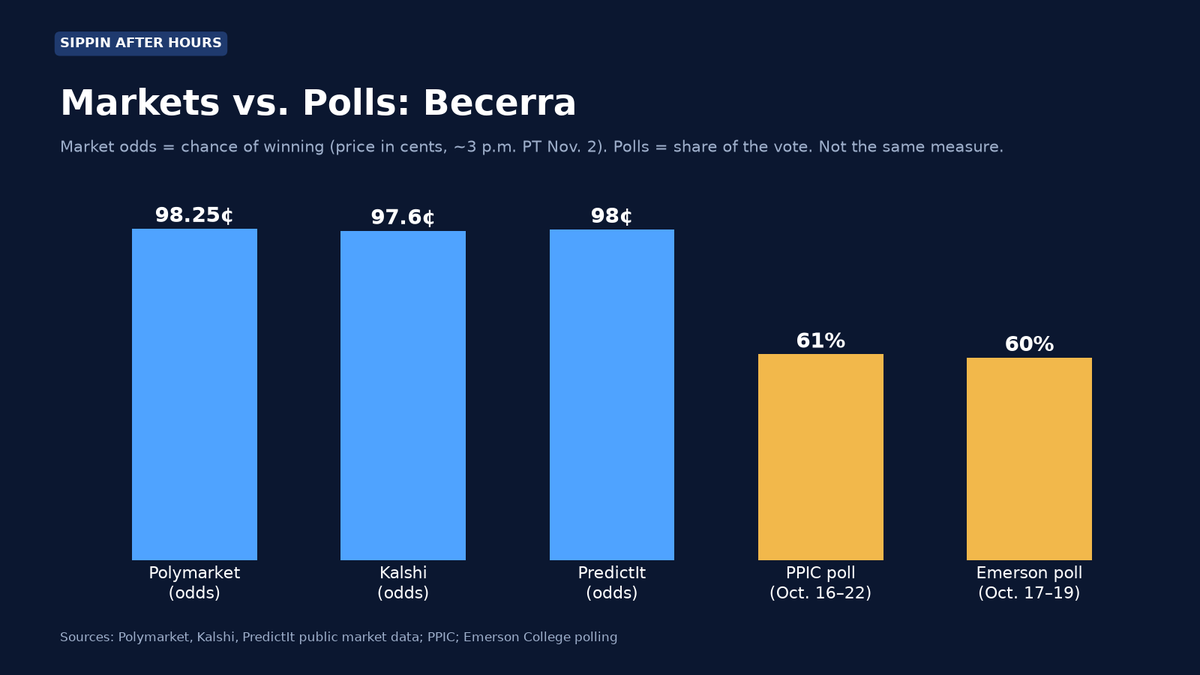
The night before California votes, the betting markets put Democrat Xavier Becerra's chances of becoming governor at about 98%. The polls have him at around 60% of the vote. Those numbers get screenshotted, shared and quoted on cable like they're the same thing. But there's a question almost nobody can answer: who is actually placing the bets that set the odds?
For the most part, the public can't see that. Sippin thinks that needs to change.
The numbers right now
As of about 3 p.m. Pacific on Monday, Nov. 2:
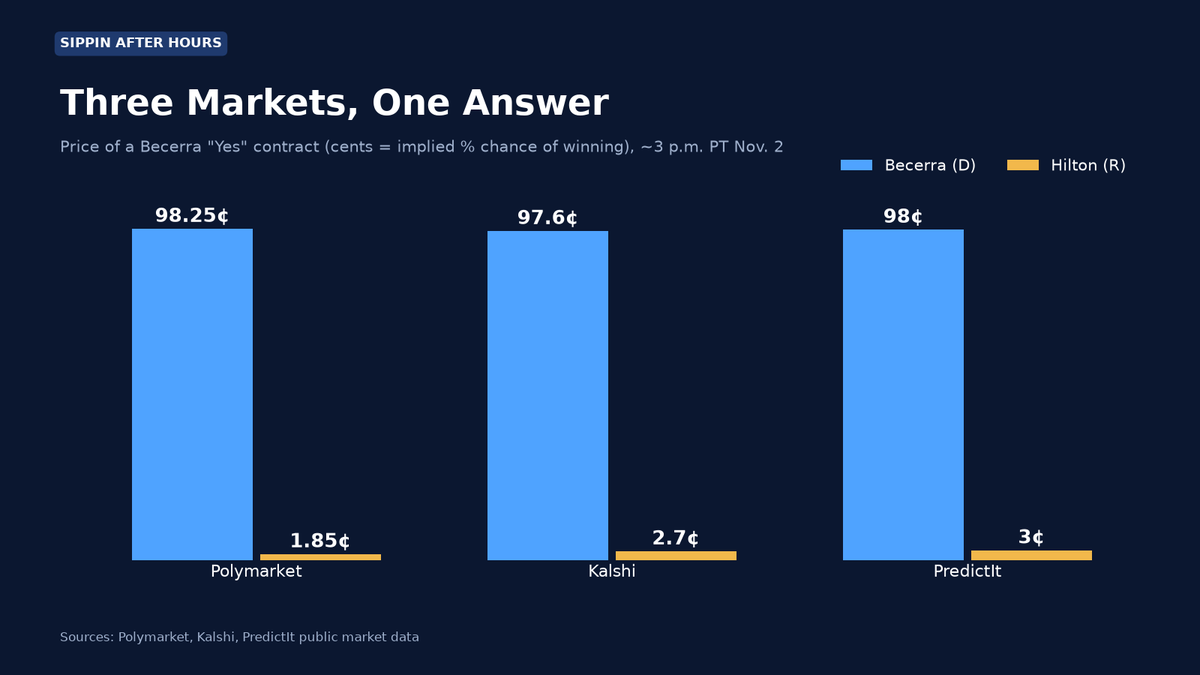
- Polymarket priced a Becerra "Yes" at 98.25 cents and Republican Steve Hilton at 1.85 cents, according to the platform's public market data. The full event has drawn about $44 million in volume.
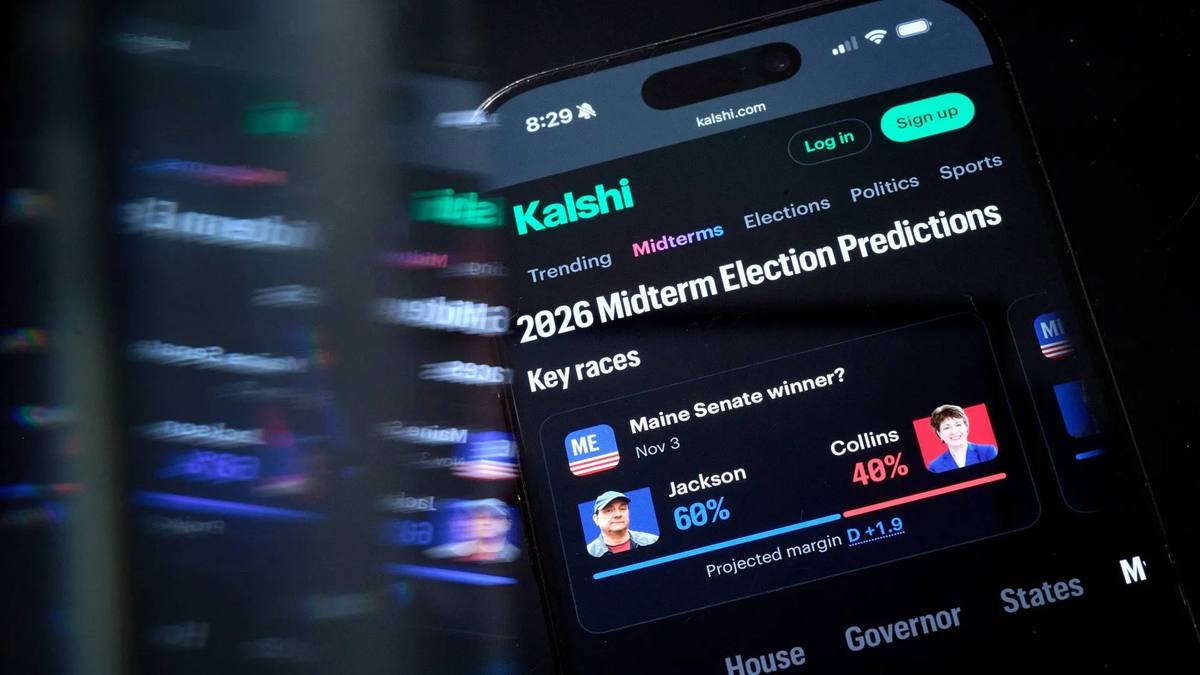
- Kalshi had Becerra at 97.6 cents and Hilton at 2.7 cents, according to Kalshi's public data.
- PredictIt had Becerra at 98 cents and Hilton at 3 cents.
Over the same period, the polls haven't moved much:
- PPIC (Oct. 16-22): Becerra 61%, Hilton 37%.
- Emerson College (Oct. 17-19): Becerra 60%, Hilton 33%.
- The 270toWin average: Becerra 59.8%, Hilton 36.2%.
Polymarket's price history shows Becerra climbing from about 95 cents in mid-September to about 98 cents now. Nothing in the polls says the race is tightening.
To be fair, 98% and 60% aren't contradicting each other. A poll estimates vote share. A market price is supposed to be the chance of winning. A candidate leading by 20-plus points should be a near-lock. This race's odds look like the polls. That isn't really the problem.
The problem is that when odds don't look like the polls, voters have no way to tell whether they're seeing smart money or somebody with an agenda.
What the markets tell you about who's trading
Polymarket International, the crypto-based site at polymarket.com, doesn't require ID for most users, according to Polymarket's own transparency page. Every trade is recorded permanently on a public blockchain. Polymarket calls it "the least anonymous financial market of all time" because anyone can trace a wallet's full history. But a wallet is a string of characters, not a name. The trades are pseudonymous. You can see what a wallet did, not who owns it. Polymarket says it "requests additional information from top-volume traders." That information isn't published. U.S. users are barred from the international site.
Polymarket US and Kalshi are both regulated by the Commodity Futures Trading Commission (CFTC). Both require full identity checks: government ID, Social Security number and proof of address, according to Polymarket and industry KYC guides. So the platforms, and regulators if they ask, know who's trading. The public doesn't. Neither publishes who holds large positions in an election market.
Kalshi does publish disciplinary notices. Its rules bar anyone who can influence an outcome from trading on it. The Wall Street Journal reported that this covers candidates in their own races and people employed by PACs.
The cases we know about
A candidate in this very race. Kalshi banned Kyle Langford, a former Republican candidate for California governor, for five years. According to Kalshi's notice of disciplinary action, effective Feb. 25, 2026, he placed trades on the governor's race and promoted them on social media. Axios reported the trades were about $200. Kalshi fined him $2,246.36. Wired and Politico reported that Kalshi also blocked Stephen Cloobeck, a Democratic megadonor who briefly ran for governor, from trading on the race.
The $44,000 Mahan spike. Bloomberg reported that on the day San Jose Mayor Matt Mahan entered the race in January, a Polymarket user called "Fine-Tributary" spent $44,000 on "Yes" contracts for Mahan. His price jumped from the low teens to 96 cents. Other traders sold it back down, but Bloomberg reported that Polymarket still gave Mahan a 36% chance the next day. It's still not publicly known who was behind the trade or why.
Theo, the 2024 whale. In 2024 an anonymous French trader put tens of millions on Donald Trump across several Polymarket accounts. The Wall Street Journal and others raised the question of whether the bets were creating false momentum. Polymarket told The New York Times the trader was "taking a directional position based on personal views of the election" and said it found no evidence of manipulation. CNBC later reported he made about $85 million. The public only learned who was behind those accounts because reporters and on-chain sleuths dug it up.
How cheap it is to move a market. CNBC reported on Oct. 30 on data from the Anti-Corruption Data Collective, a Washington, D.C., nonprofit:
- Of 18,000 active congressional markets on Polymarket and Kalshi, 88% could have their price moved 10 cents with a single bet under $1,000.
- About 23% of the larger congressional markets saw spikes of 30 cents or more.
CNBC also noted that a suspicious-looking trade can just be a sharp bettor or an enthusiastic supporter.
What the rules say now
The CFTC. On Feb. 25, 2026, the CFTC issued an advisory on insider trading in prediction markets, according to the Congressional Research Service. It said the Kalshi-disciplined candidate "potentially" violated the agency's anti-fraud Rule 180.1. It also said exchanges have an independent duty "to maintain audit trails, conduct surveillance, and enforce rules against prohibited practices." CRS noted the CFTC hadn't brought an enforcement action against the trader. CRS also said it's legally unsettled how far Rule 180.1 reaches beyond traditional insider-trading theory.
The FEC. We found no FEC rule or advisory opinion that addresses campaigns or PACs trading election contracts.
Congress. Bills are pending but none have passed, according to CRS:
- H.R. 8771, the Campaign Event Contract Integrity Act:
- It would bar people tied to campaigns and PACs from trading political contracts while holding nonpublic campaign information.
- It would require platforms to report suspicious activity to the CFTC.
- It would make traders above CFTC-set thresholds disclose any campaign affiliations.
- H.R. 8912, the Campaign Funds Integrity Act of 2026: It would amend federal campaign finance law so candidates and political committees can't use campaign funds on prediction markets at all.
- Broader bills, including S. 4060 and the STOP Corrupt Bets Act, range from banning manipulation and conflicts of interest to banning election contracts outright.
Our read: today, a federal PAC isn't clearly barred by federal law from betting campaign money on an election market. Platform rules like Kalshi's are doing most of the work.
Sippin's take: what transparency should look like
These are our suggestions. Some come from the bills above, and the rest follow from the gaps:
- Public large-position disclosure. Once someone holds a big stake in an election market, say a set dollar amount or share of open interest, the platform should publish it with an identity or a verified entity type. Stock investors already have to disclose big stakes in companies. Election odds deserve at least that.
- Ban campaigns and PACs from betting, or at least make them disclose it. H.R. 8912's approach, banning campaign funds in these markets, is the cleanest. At minimum, any trade by a candidate, committee or PAC should be reportable to the FEC and visible to the public.
- Affiliation checks at signup and above thresholds. H.R. 8771 would require this. Apply it on every platform, including offshore sites that are quoted in U.S. coverage.
- Audit trails the public can actually read. The CFTC already expects exchanges to keep audit trails. Regulated platforms should publish regular integrity reports on election markets: big price spikes, flagged trades and what happened next.
- Label the odds when you quote them. Media that cite market odds should give the volume and say they're not polls. That one's on us too.
The bottom line for California
To be clear, there is no evidence that any PAC or campaign is moving the odds in the Becerra-Hilton race. The market prices are in line with the public polling. We found no credible reporting of PAC betting on this general-election market.
But "there's no evidence" shouldn't depend on reporters and blockchain sleuths happening to look. If these numbers are going to be treated like news, voters deserve to see who's behind them.
Polls close at 8 p.m. Pacific on Tuesday. The real odds get settled then.